From Chaos to Cadence: How Scaling Companies Find Their Rhythm
Leadership cadence helps leaders bring rhythm to growth, turning chaos into clarity and consistent progress.
Every scaling company has chaotic beginnings. Early momentum feels electric — ideas spark, decisions happen fast, and everyone moves with instinct and urgency. But as teams expand and expectations rise, what once felt like clarity begins to fracture into disorganization.
It’s not a failure of vision. It’s a matter of rhythm. Leadership cadence is what turns reactive leadership into rhythm and clarity.
Growth demands coordination. Providing cadence sustains it. Leadership cadence matters!
The Myth of Controlled Chaos
Founders often misconstrue chaos as a sign of drive, adaptability, and boldness. However, chaos is a phase — not a useful strategy.
At some point, chaos starts to work against the organization. While teams may double their efforts to meet demands, they often lose focus and direction. This indicates that controlled chaos does not equate to true control. Often, it’s exhaustion disguised as productivity.
Leaders who recognize this early make the shift from speed to rhythm. They begin to weave cadence — a system of discipline that brings structure without suffocating agility — into their leadership.
Though chaos can create motion, cadence creates progress. As TechCrunch notes, sustained growth isn’t born from speed — it’s built through rhythm, structure, and leadership discipline.
Leadership Cadence in Action
Cadence is the heartbeat of execution. It’s how strategy becomes practice.
When companies introduce a consistent rhythm — weekly priorities, leadership meetings, pulse check-ins — they create consistency. That consistency compounds into confidence.
When confidence grows, teams begin to anticipate decisions rather than react to them. Priorities become predictable. Communication stabilizes, which ultimately accelerates stability within the company.
The correct cadence allows leaders to spend less time problem solving and more time focusing on aligning direction, decisions, and people.

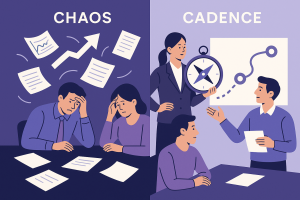 From chaos to cadence — leadership as rhythm in motion.
Leadership Rhythm as a Competitive Advantage
Cadence requires systematic precision. The strongest organizations understand they cannot rely on bursts of intensity. Instead, they rely on rhythm. They recognize that sustainable performance comes from predictability rather than pressure.
A well-designed leadership rhythm provides three advantages:
- Clarity — Everyone knows what matters and when it matters.
- Connection — Teams build trust through consistent collaboration.
- Confidence — Leaders make decisions based on pattern, not panic.
TechCrunch recently observed that “The difference between startups that scale and those that stall isn’t talent — it’s rhythm.”
That insight showcases why cadence is a cultural concept even more than a management concept. Companies that find rhythm consistently outperform those that rely on hustle. This is because cadence creates context — and context drives performance. Learn how founders evolve their leadership rhythm in The Future Role of the Founder — From Operator to Strategic Leader.
As one Founder put it, “Cadence doesn’t remove complexity — it transforms it into coherence.”
The Founder’s Role
Every Founder hits the point where intensity alone stops working. The business becomes too complex, and the team becomes too dependent on their presence. That’s when the Founder must transition from being the engine to becoming the metronome.
Leaders set rhythm through their consistency. They model discipline, clarity, and follow-through. They ensure that goals, decisions, and accountability all align in tempo.
And when they do, energy stops leaking. Teams stop waiting for direction and start building momentum together.
Rhythm replaces reactivity.
The Impact of Moving from Chaos to Cadence
The impact of moving from chaos to cadence is transformative. Decisions get cleaner and chaotic productivity is ultimately replaced by shared clarity. As Forbes reinforces, that finding the right company cadence transforms speed into sustainability. When leaders shift from reaction to rhythm, clarity compounds across every layer of the organization.
Cadence turns growth from accidental to intentional. Teams become self-correcting. Accountability turns from pressure into pride. Culture stabilizes, and trust grows as promises turn into patterns.
And that’s the shift that separates leaders who scale organizations from those who simply survive them.
The Cost of Operating Without Cadence
Founders rarely fail due to lack of effort. They struggle when pace outgrows structure. Without cadence, every decision feels urgent, every meeting becomes reactive, and execution loses its rhythm. The most effective Founders don’t just work harder — they create systems that reduce noise, strengthen alignment, and protect time for what matters most. Leadership cadence frees the organization from guesswork and gives people a consistent pattern to operate within. When cadence becomes habit, clarity accelerates, accountability sharpens, and results compound.
————-
Evoldera Q&A | Organizational Rhythm for Founders
Q1: Why does organizational rhythm matter for Founders and Owners?
Because rhythm creates predictability — and predictability creates performance. When a company scales, rhythm is the difference between a team that surges forward and a team that constantly resets.
Q2: What is the biggest mistake Founders make during scaling?
Confusing activity with cadence. Many push harder instead of building structured rhythm — which leads to burnout, rework, and misalignment.
Q3: What shifts when a Founder creates consistent cadence?
Meetings get shorter. Priorities sharpen. Teams self-correct. Cadence becomes a force multiplier — reducing noise and creating momentum everyone can feel.
Q4: How does this connect to Evoldera’s values?
Cadence turns Alignment into action.
It turns Responsibility into follow-through.
It turns Outcomes into a repeatable system instead of a one-time win.
Q5: What is one reflective question a Founder should sit with?
“If my team repeated this week 52 times, would we end the year where we want to be?”
———–
T-Mic Drop | Clarity fuels rhythm. Cadence scales results.
———–
Clarity doesn’t arrive by chance — it’s earned through reflection and responsibility.
Take a moment: where in your leadership could more clarity create new outcomes?
———–
Values Anchored | Alignment. Responsibility. Outcomes.
Written by Tushar Pandit, Founder of Evoldera — providing leadership advisory for Founders and Owners to align strategy with execution and deliver lasting outcomes.
