The Leadership Trap: When Everyone Thinks They’re Aligned… Until They Aren’t
Every founder has lived this moment.
A project falls apart. A client deliverable misses the mark. Or two leaders walk into your office with opposite interpretations of the same decision.“
And you catch yourself asking, ‘How did we all leave the same meeting with different understandings of what we were doing?’”
Inc. indicates leaders often underestimate how much teams guess, interpret, and fill in the blanks.
Alignment didn’t break overnight. It quietly eroded.
As companies grow, decisions multiply faster than shared understanding. Teams begin filling gaps with assumptions. Execution continues — but alignment thins and momentum weakens.
This is the leadership trap: everyone believes they’re aligned… until the work proves they aren’t.
Advisory alignment isn’t about consensus or more meetings.
It’s about removing hidden assumptions before they harden into execution drag.
Founders who scale well don’t just decide faster — they ensure decisions are understood the same way, at every level.
At a Glance
- Misalignment happens when expectations outpace what’s been explicitly agreed.
- When roles and decision rights are implied instead of stated, people fill gaps with assumptions.
- Assumptions create drag: mixed signals, second-guessing, and slower decisions.
- This week: clarify what you want, define where input ends, and name who decides what.
Assumptions Are the Hidden Cost of Scale
Assumptions are dangerous because they feel like alignment right up until execution exposes the truth. Leaders often underestimate how much teams guess, interpret, and fill in the blanks when direction is incomplete.
Your job as a Founder isn’t to talk more or micromanage harder. Your job is to remove the conditions where assumptions thrive—so teams can move fast without guessing.

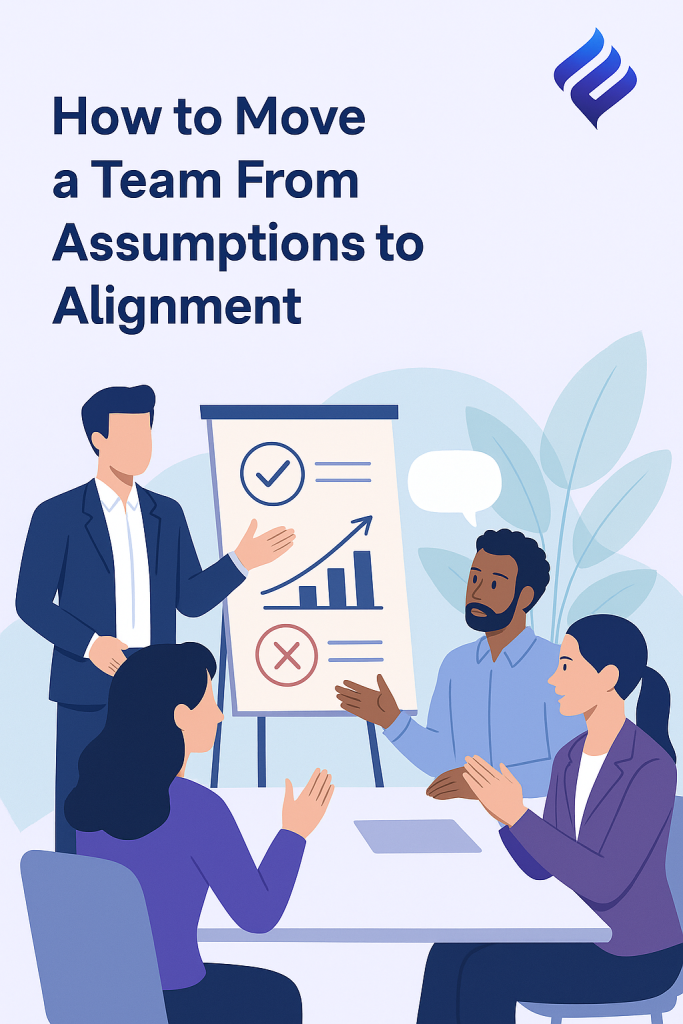 From assumptions to alignment: clarify roles, decision rights, and expectations.
Why Teams Default to Assumptions
People don’t make assumptions because they’re careless. They make them because they’re human—and because speed plus ambiguity is a powerful forcing function.
When things move fast, details are fuzzy, and leaders believe they’ve been clear, teams fill in the gaps just to keep moving. The faster the company scales, the more this pattern accelerates because the communication system rarely scales at the same pace as headcount and complexity.
- Teams grow faster than communication systems.
- Decisions multiply.
- Ownership becomes blurry.
- Roles shift faster than expectations.
Left unaddressed, assumptions show up as real costs: rework, slower decisions, missed handoffs, and the kind of “busy work” that looks like progress until outcomes stall.
- Execution misses and rework
- Broken trust and second-guessing
- Frustration and silent resentment
- Busy work that masks misalignment
Alignment Isn’t Agreement
One of the biggest Founder misconceptions is this: if everyone nods in the meeting, we’re aligned. Nodding does not equal alignment. Agreement does not equal alignment. Silence definitely does not equal alignment.
Alignment means shared understanding—expressed the same way by different people—and then reinforced through consistent execution. You’ll know you have it when priorities, success criteria, ownership, and decision paths match across the team (and match the execution you see).
- The same priorities
- The same definition of success
- The same ownership map
- The same decision path
A client once said it perfectly: “Our meetings feel aligned. Our execution tells a different story.” That’s the tell.
How Leaders Unintentionally Create Assumption-Driven Teams
There are three common Founder behaviors that unintentionally invite assumption-making. None of them come from bad intent—they come from speed, pressure, and the Founder’s role as the primary sense-maker. As Entrepreneur indicates, decision fatigue is real — and a simple framework can reduce churn.
First: moving too fast. When pace outruns comprehension, people guess to keep up. Second: compressing decisions. “We’ll figure it out later” is often heard as “fill in the blanks.” Third: thinking out loud. What you label brainstorming, your team can hear as direction—unless you explicitly separate exploring from deciding.
How to Foster Alignment in Your Company
Here’s a practical Founder playbook for operational alignment—built to reduce assumptions without slowing momentum. The goal isn’t more process; it’s fewer gaps.
- Slow the moment, not the company. Ask clarifying questions in the room, not after things break.
- Define ownership before action. If no one owns it, everyone assumes someone else does.
- Replace “Any questions?” with “Tell me your understanding.” This surfaces gaps instantly.
- Align on the problem before the solution. Misalignment usually starts with different definitions of the problem.
- Document the decision in one place. Verbal clarity dissolves; written clarity aligns.
- Eliminate ambiguous language. Words like “soon,” “ASAP,” “priority,” “revise,” and “tighten up” are assumption magnets—translate them into outcomes and dates.
Related: Why Founders need an Advisor.
Advisory Alignment: The Reset When Execution Slips
Misalignment isn’t just a communication problem. It’s a leadership system problem.
Companies don’t scale on charisma. They scale on clarity. Your job isn’t to answer more questions—it’s to build the conditions where your team doesn’t have to guess.
Alignment doesn’t happen because you talked about it. It happens because you engineered it. If you’re scaling and want a leadership operating rhythm that removes assumptions from your business, let’s talk. Advisory support helps Founders build clarity, cadence, and alignment where it matters most.
————-
Q&A
Q1: Why do teams default to assumptions even when founders believe they’re clear?
A: Speed + ambiguity is the perfect recipe. Fast growth, unclear ownership, and compressed decisions push teams to interpret rather than clarify. Most assumptions form in the gap between what leaders intended and what teams heard.
Q2: How can founders tell if their team is aligned or just agreeing?
A: Alignment shows up in execution consistency, not nodding heads. If deliverables vary, priorities shift, or people ask follow-up questions after meetings, the team is not aligned.
Q3: What’s one practice founders can use this week to improve alignment?
A: End every meeting with three questions: (1) What did we decide? (2) Who owns what? (3) When is it due? This eliminates most assumptions immediately.
Q4: How do I clarify decision rights without creating bureaucracy?
A: Keep it lightweight: define who recommends, who decides, who executes, and who must be consulted. You’re not adding process—you’re removing confusion.
Q5: What’s the fastest way to reduce rework across a growing team?
A: Write down the “definition of done” before work starts: what good looks like, what’s included/excluded, and how success will be measured. Rework usually comes from missing standards, not missing effort.
————-
T-Mic | Alignment is explicit. Assumptions create drag.
————
Founder Cadence Diagnostic
If this feels familiar, it’s often a signal that leadership cadence—not effort—has stopped scaling with the business.
The Founder Cadence Diagnostic is a focused 30-minute working session designed to surface where rhythm, priorities, or decision rights are breaking down—and what to reset first.
Clarity before complexity compounds.
————
Values Aligned | Alignment. Responsibility. Outcomes.
Written by Tushar Pandit, Founder of Evoldera — advising founders to establish clarity, cadence, and operating rhythm as they scale.
