How to Reset Cadence When Everything Is Moving Too Fast
Founders don’t lose control overnight. They lose it in increments—one extra priority, one more “urgent” request, one more meeting added to keep things moving.
If your calendar is full and your team is busy—but outcomes still feel uneven—cadence has already broken.
More activity is not the same as forward motion.
As the company scales, the work multiplies faster than your ability to reset context. Meetings accelerate. Priorities shift weekly. Execution becomes reactive. Teams look productive, but results wobble.
Resetting cadence doesn’t mean slowing the company down. It means regaining control of the rhythm—so growth doesn’t outrun clarity. It means making pace intentional instead of reactive.
At a Glance
- Cadence breaks when growth outpaces recalibration—and the business becomes reactive.
- The organization mirrors the Founder’s pace (intentional or not).
- Speed isn’t the goal—direction is. Velocity beats frenetic motion.
- A weekly cadence reset restores context, decision rights, and priorities—without adding bureaucracy.
The Pace of the Company Is the Pace of the Founder
Every organization adopts the rhythm of its Founder. If your weeks are fragmented, your team’s weeks become fragmented. If your priorities shift mid-sprint, your leaders learn to hedge. If decisions are made in the room but not reinforced in writing, people fill the gaps with assumptions.
This is why cadence is a leadership tool—not a scheduling tool. Your calendar is one of the loudest cultural signals in the company. It tells people what matters, what can wait, and what the organization truly rewards.
When cadence weakens, three things show up fast: decision churn, context switching, and quiet drift in accountability.
When Pace Outruns Clarity, Leaders Default to Firefighting
Early-stage urgency can create traction. But as complexity grows, urgency without recalibration becomes a scaling barrier. The fastest companies are not the ones that move the most—they’re the ones that move with shared context.
When context is missing, leaders compensate by staying ‘on call’: answering more questions, attending more meetings, and reacting to issues in real time. That feels like leadership. But it’s usually a sign that cadence has collapsed.
If you want a practical lens on why leaders need to slow down to make better decisions—even in fast environments—see this Inc piece by Jerry Colonna.
What Broken Cadence Quietly Costs
Broken cadence rarely looks dramatic at first. It shows up as small inefficiencies that compound over time.
Left unchecked, it creates:
- Leaders waiting for confirmation instead of owning outcomes
- Decisions revisited across multiple meetings
- Rework caused by shifting priorities and incomplete context
- A founder becoming the bottleneck—without realizing it
These costs don’t show up on dashboards. They show up as stalled momentum, inconsistent execution, and growing fatigue at the leadership layer.

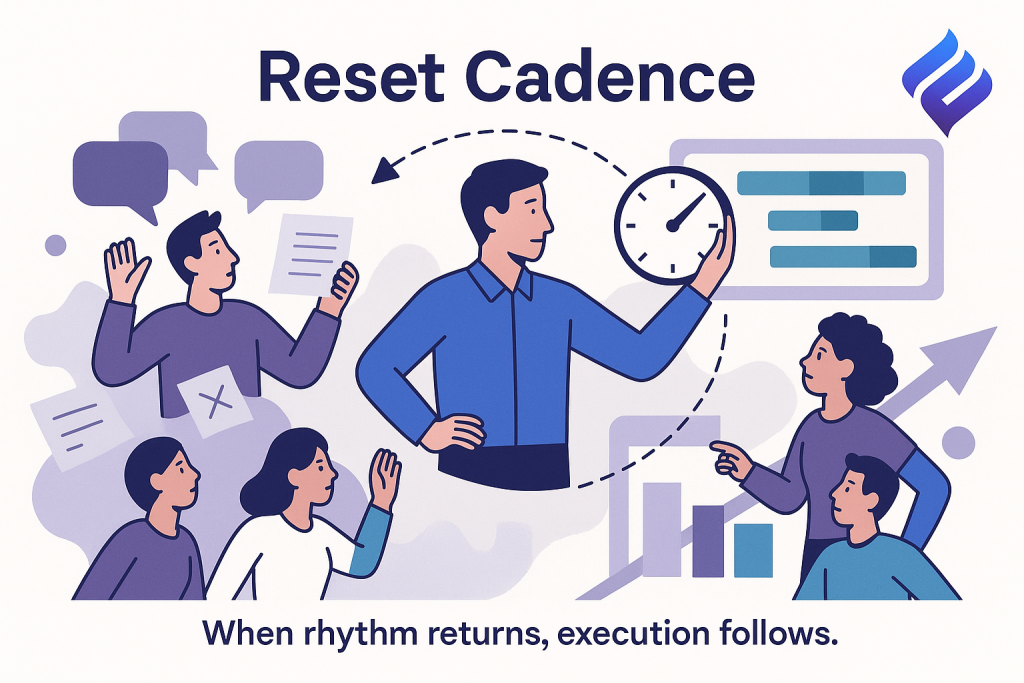 Reset cadence: when rhythm returns, execution follows.
Fast Is Good. Frenetic Is Not.
There’s a meaningful difference between speed and velocity. Speed is movement. Velocity is movement in the right direction. When your team is moving fast but rewriting priorities every week, you don’t have velocity—you have churn.
Frenetic motion creates two hidden costs: decision fatigue (leaders burn time choosing and re-choosing) and execution debt (teams build work that has to be rebuilt).
For a second lens on decision cadence and why timing matters as much as the decision itself, see this Forbes Business Council article on establishing a decision cadence.
Resetting Cadence Starts With Resetting Context
Cadence isn’t built through calendars or schedules. Those tools only reinforce a cadence that already exists. Cadence begins with context: what the company is trying to do, what matters this quarter, and what “good” looks like this week.
A simple test: if your team keeps moving but outcomes are inconsistent, the missing ingredient is usually context—not effort. Context reduces guessing. Guessing slows execution.
A Founder’s Weekly Cadence Reset
A weekly reset is not another meeting. It’s a leadership ritual that protects focus. Done well, it prevents drift before it becomes firefighting.
A strong weekly cadence reset includes:
- Re-center the quarter: restate the 2–3 priorities that matter most (plain language).
- Reconfirm ownership: name who owns what outcomes—especially cross-functional work.
- Remove hidden priorities: kill or pause one thing that’s stealing capacity.
- Reset expectations for pace: what must be true by Friday (not what must be ‘worked on’).
- Reinforce decision rights: clarify where input ends and who makes the call
- If this 30-minute reset feels hard to run—or hard to sustain—that’s usually a sign the cadence problem is systemic, not personal.
This takes 30 minutes. The payoff is measured in fewer follow-up questions, fewer rehashes, and more consistent execution.
Related
Related: Moving a Team From Assumptions to Alignment
———–
Advisory Lens: Cadence Is a System, Not a Personality
Founders often assume cadence is a personal trait—some leaders are ‘structured,’ others are not. In practice, cadence is a system that must scale as complexity increases.
When founders reach Evoldera, it’s rarely because execution is broken. It’s because cadence no longer supports the level of decision-making, ownership, and coordination the business now requires.
Rebuilding cadence restores rhythm—so leaders spend less time syncing and more time driving outcomes.
———–
Q&A
Q1: What’s the clearest signal that cadence has broken?
A: When priorities change mid-week, decisions get revisited in multiple meetings, and leaders spend more time syncing than executing. Busy rises; outcomes wobble.
Q2: Why does cadence collapse as the company grows?
A: Complexity increases faster than the organization’s ability to reset context. Without a weekly reset, teams fill gaps with guesses and leaders default to firefighting.
Q3: What’s the difference between cadence and process?
A: Process is the ‘how.’ Cadence is the rhythm that keeps the ‘how’ aligned to the ‘what.’ Cadence prevents drift; process standardizes execution.
Q4: How do I reset cadence without slowing the company down?
A: Time-box a weekly reset to 30 minutes and make it outcome-based: priorities, ownership, one removed priority, a Friday definition of done, and decision rights.
Q5: What’s one action I can take this week?
A: Run one ‘context-first’ leadership sync: start with quarter priorities, then ask each leader to name (1) their single outcome for the week and (2) one decision they will make—plus who provides input. This turns meetings into velocity.
———–
T-Mic | Cadence creates velocity. Chaos creates churn.
———–
Founder Cadence Diagnostic
If this feels familiar, it’s often a signal that leadership cadence—not effort—has stopped scaling with the business.
The Founder Cadence Diagnostic is a focused 30-minute working session designed to surface where rhythm, priorities, or decision rights are breaking down—and what to reset first.
Clarity before complexity compounds.
———-
Values Aligned | Alignment. Responsibility. Outcomes.
Written by Tushar Pandit, Founder of Evoldera — advising founders to establish clarity, cadence, and operating rhythm as they scale.
