Skip to content
Start the Conversation
  • About
  • Services
  • Insights
  • Speaking & Media
  • Contact
  • About
  • Services
  • Insights
  • Speaking & Media
  • Contact
Start the Conversation

AI Decision Flow: Why Leaders Lose Momentum as Companies Scale

Leaders reviewing an AI-supported decision flow, showing how shared context improves decision clarity and execution.

AI doesn’t make companies faster. It makes decisions move.

As companies scale, momentum is rarely lost because teams stop working. It’s lost when decisions stop moving cleanly through the system.  Not effort. Not talent. Not even strategy. Decision flow is how leadership intent turns into action.

When decisions stall, everything around them degrades. Priorities wobble. Teams hedge. Meetings multiply. Execution turns into a series of clarifications instead of outcomes. The organization stays busy, but progress feels uneven.

Leaders notice this before it shows up in metrics. They’re still involved, still reviewing, still weighing in—but more decisions require alignment than action. The system begins to wait on itself.

This is the pressure point AI is entering. Not to automate judgment, but to restore momentum to how decisions are sensed, made, and carried forward as companies grow.

In this article, we look at why decision flow breaks as companies scale, and how leaders can strengthen it without slowing the organization down.

At a Glance

  • Execution slows when decision flow slows—because teams stop acting and start waiting.
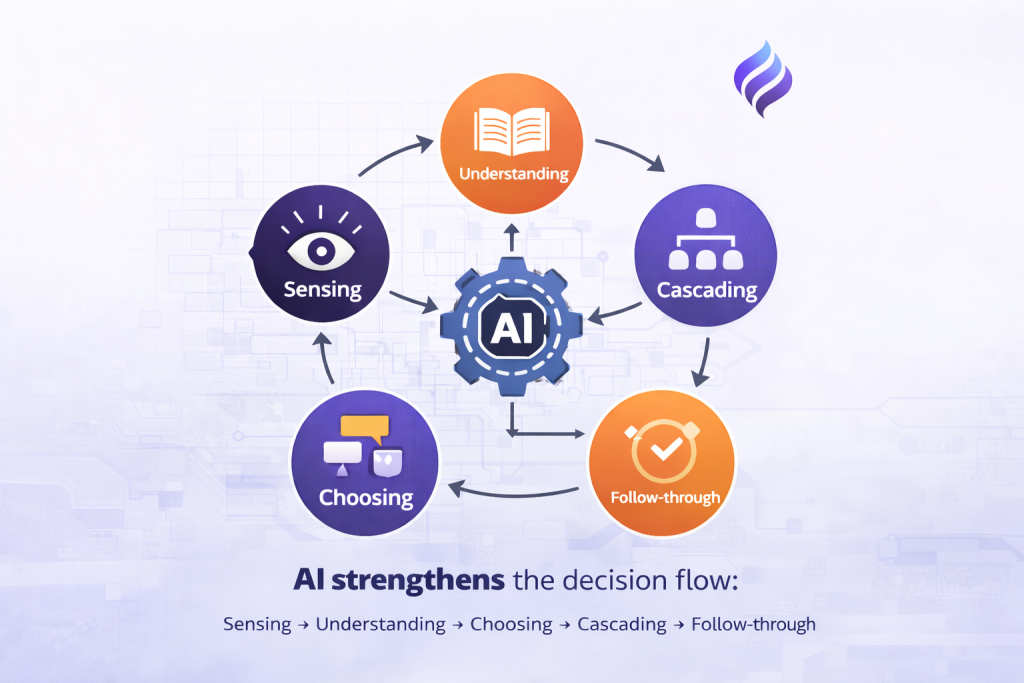
  • AI improves the decision loop: sensing → understanding → choosing → cascading → follow-through.
  • The value isn’t speed for its own sake—it’s better decisions made consistently, with clearer decision rights.
  • If AI isn’t changing how decisions move, it’s not transformation—it’s theater.

The Hidden Scaling Constraint: Decision Flow

Founders often describe scaling pain as a “communication problem” or a “focus problem.” Those are real—but underneath them is the same root cause: decisions aren’t moving cleanly through the organization.

When decision flow breaks, leaders compensate by staying closer to everything: more check-ins, more approvals, more meetings, more “just keep me in the loop.” That doesn’t restore speed. It creates dependency.

This is why growth stalls quietly. Teams don’t stop working—they slow down because decisions stop moving.  Weak AI decision flow turns leadership judgment into noise.

When AI decision flow is clear, execution accelerates without founders becoming bottlenecks.

AI Doesn’t Speed Up Work. It Speeds Up the Decisions That Drive Work.

The biggest misconception is that AI “makes companies faster.” Speed is the outcome, not the input.

AI accelerates the decision loop by reducing blind spots and compressing the time it takes to reach shared understanding. Entrepreneur makes a related point: AI turns decision-making from a private process into a shared framework—so teams can trust outputs and move without guessing.

But the point isn’t to decide faster at any cost. The point is to decide with clarity, consistency, and accountability—so execution becomes predictable.

The Decision Loop—and Where It Breaks

Most scaling companies run the same five-stage decision loop. When any stage is weak, the organization pays for it in rework and delay.

  1. Sensing: capturing what’s happening (signals, customer language, market shifts).
  2. Understanding: turning signals into shared context and options.
  3. Choosing: making the call (decision rights, criteria, trade-offs).
  4. Cascading: communicating the decision so teams can execute without interpretation.
  5. Follow-through: tracking outcomes, seeing drift early, and correcting course.


AI decision flow showing how leadership decisions move through a scaling organization
AI decision flow clarifies how decisions translate into aligned execution as companies scale.

AI Decision Flow Is the Hidden Scaling Constraint

Where AI Strengthens Each Stage

AI is most powerful when it removes friction in the loop—not when it generates more output.

  • Sensing: summarize customer calls, surface patterns, and detect shifts in language or objections.
  • Understanding: compress research cycles and generate clearer options + trade-offs for leaders.
  • Choosing: pressure-test criteria, expose second-order consequences, and make assumptions visible.
  • Cascading: draft crisp decision narratives so teams share the same understanding.
  • Follow-through: track leading indicators, capture learnings, and flag drift before it becomes a miss.

Fast Company argues that leaders in the AI age need better decision rituals—not just better decisions. AI can support those rituals, but leadership still owns the discipline. (External reference below.)

The Advisory Lens: Decision Rights Still Matter More Than Tools

AI won’t fix unclear decision rights. If ownership and decision authority are ambiguous, AI just makes the confusion faster.

The “AI advantage” shows up when leaders tighten decision rights, define decision criteria, and build a cadence for how decisions move. That’s when AI becomes leverage instead of noise.

In other words: AI improves decision quality. Leadership improves decision integrity. You need both.

A Simple AI Decision Flow Practice for Founders and Leadership Teams

If you want to turn this into operating rhythm (not an experiment), run one decision flow every week on a real decision—not a hypothetical one.

  1. Pick one decision that matters (pricing, roadmap trade-off, GTM bet, org design).
  2. Define decision rights: who decides, who provides input, and what “done” means.
  3. Use AI to build shared context: options, pros/cons, risks, second-order effects.
  4. Make the call—and write the decision narrative in plain language.
  5. Cascade + track one leading indicator for follow-through.

Strong AI decision flow keeps authority clear as scale increases.

The win isn’t “AI usage.” The win is faster alignment and cleaner execution.

——-

Related

Related: AI as the Founder’s Commercial Engine

——-

Q&A

Q1: Does AI replace decision-making?

A: No. It strengthens the conditions for decision-making—shared context, clearer options, and faster understanding—while leaders remain accountable for judgment and trade-offs.

Q2: Where does AI have the fastest impact in a scaling company?

A: Understanding. When teams align on context and options faster, choosing and cascading become dramatically cleaner.

Q3: Why does execution improve when decision flow improves?

A: Because teams stop waiting for clarification and stop re-litigating decisions. Clarity compounds into momentum.

Q4: How does AI reduce Founder dependency?

A: By distributing decision criteria and context. The Founder isn’t the bottleneck for clarity—clarity becomes a system.

Q5: What’s one action a leadership team can take this week?

A: Run one AI-supported decision flow on a real decision. Time-box to 60 minutes. If the decision narrative isn’t clear enough for someone outside the room to execute, it isn’t done.

———-

T-Mic | When decisions move, everything moves.

——–

Founder Cadence Diagnostic

If this feels familiar, it’s often a signal that leadership cadence — not effort — has stopped scaling with the business.

If helpful, I offer a 30-minute Founder Cadence Diagnostic — a focused working session designed to surface where rhythm, priorities, or decision rights are slipping — and what to reset first.

Clarity before complexity compounds.

———

Values Aligned | Alignment. Responsibility. Outcomes.

Written by Tushar Pandit, Founder of Evoldera — advising founders to establish clarity, cadence, and operating rhythm as they scale.

Start the Conversation

Client Testimonials

Trusted by Leaders

Clients credit our work with sharper thinking, stronger alignment, and decisions that hold. These reviews reflect what changes when leadership clarity is restored and founders lead with rhythm instead of reaction.

CEO Advisory

At a critical inflection point in our company’s growth, I engaged Tushar for executive coaching. He proved to be an invaluable asset – listening deeply, quickly assessing the dynamics, and offering clear, actionable guidance. He also introduced effective strategies to hold both myself and my team accountable. The sessions were incredibly impactful, and I walked away with greater clarity and focus. I highly recommend Tushar to any leader navigating complex challenges or pivotal transitions.
Chris Tucker, enhance HCM

Chris Tucker

President, Enhance HCM

Leadership Advisory

Tushar’s coaching was very impactful. As a first-time executive at a high-growth SaaS company, I was challenged with managing expectations from the C-Suite and knowing when/how to voice my point of view with clarity and authority. Tushar provided me with the tools to frame those conversations that have helped me to grow as a leader and executive. Cannot thank and recommend him enough!
Steve Botz, CRO

Steve Botz

Chief Revenue Officer, RM ONE

Leadership Advisory

Working with Tushar was a game-changer for my career. He quickly pinpointed the core issues holding me back, helping me overcome my hesitation. Through powerful questions and active listening, Tushar provided the clarity I needed. Tushar’s support wasn’t just about preparing me for a leadership role; it was about equipping me with the confidence and tools for long-term growth. His guidance on leadership deliverables and strategic communication has been invaluable, and I highly recommend him to anyone looking to level up their impact.

VP, Product Marketing, Software Company

CEO Advisory

Tushar Pandit brings a rare combination of deep operational expertise, strategic clarity, and extensive network access. From day one, he has helped refine our product roadmap, shape our go-to-market approach, and unlock critical business development opportunities. His ability to think both strategically and tactically has strengthened our vision and investor thesis. Any founder would be fortunate to have Tushar as a trusted advisor and partner at the board level.
Jeet Mukerji - Kinfolk

Jeet Mukerji

CEO & Co-Founder, Kinfolk

CEO Advisory

Partnering with Tushar has given me clarity and confidence in many leadership moments and decisions. As a Founder, having a trusted advisor who can both challenge my assumptions and provide a steady perspective has been invaluable. Tushar’s guidance on everything from GTM to our company’s strategic direction has helped me navigate complexity and scale. I would recommend him to any Founder seeking perspective that truly drives outcomes.
Alexei Dunaway - Pinnacle

Alexei Dunaway

Founder & CEO, Pinnacle AI

CEO Advisory

We are honored to have Tushar Pandit serve as a trusted Advisor to ChangeEngine. Over the past four years, Tushar has played a pivotal role in shaping our growth and direction through his guidance, expertise, and unwavering support. From helping design our initial go-to-market strategy to steering us through the complexities of a major product evolution, Tushar’s insights have consistently proven transformational. His ability to challenge us thoughtfully during monthly advisory discussions has sparked breakthrough decisions, including expansion into new verticals and enhancements to our product modules. Tushar combines strategic vision with a collaborative style that inspires confidence and drives results. His depth of experience has been invaluable to our journey, and we are deeply grateful for his continued partnership. To any founder seeking a seasoned, impactful Advisor, we wholeheartedly recommend Tushar.
Andrew Higashi - ChangeEngine

Andrew Higashi

CEO & Co-Founder, ChangeEngine

How do I start?

Start with a conversation to align on priorities and current demands.

If there’s a fit, we establish a clear direction and working rhythm.

What does an engagement look like?

All engagements run six, nine, or twelve months and follow a steady working rhythm.

The work requires continuity to hold and shorter engagements do not give the rhythm time to compound.

Sessions are virtual by default, with onsite time used intentionally when it adds value.

What's included, and how is billing handled?

Sessions and working sessions are included. Travel and assessments are billed separately.

Is this consulting?

No. This is focused on clarity, alignment, and disciplined execution. We work alongside you to restore clarity and operating rhythm rather than to produce reports.

Who do you work with?

CEOs and leadership teams navigating growth-stage complexity, including venture-backed, private equity–backed, and public companies.

Is there a minimum commitment period?

Yes. Most engagements begin with a six-month commitment to ensure the right rhythm, continuity, and measurable outcomes.

How are sessions structured?

Sessions follow a consistent rhythm, combining dialogue, reflection, and action.

Each builds on the last to reinforce clarity, alignment, and disciplined follow-through.

How do you know the work is holding?

The signal is clearer direction, tighter leadership alignment, and more consistent execution.

When those improve, decisions close faster, priorities hold longer, and teams move with less friction, which are the visible markers of rhythm doing its work.

Are engagements confidential?

Yes. All conversations are fully confidential. Trust and discretion are core to every engagement.

Have Questions?

Frequently Asked Questions

These are the questions CEOs and Owners often ask when exploring a partnership with Evoldera; designed to provide clarity, context, and confidence before beginning the work.

Start the Conversation

Start a Conversation

Execution is slowing. This is the conversation to start.

Growth creates complexity. Decisions slow, leadership alignment weakens, and execution becomes harder than it should be.

Evoldera helps CEOs and leadership teams restore decision ownership, strengthen alignment, and build the operating discipline needed to scale with confidence.

Let’s start the conversation.

2026 © Evoldera All Rights Reserved.

  • Privacy Policy

Website Design by Adrian Martinez

  • About
  • Services
  • Insights
  • Speaking & Media
  • Contact
  • hello@evoldera.com